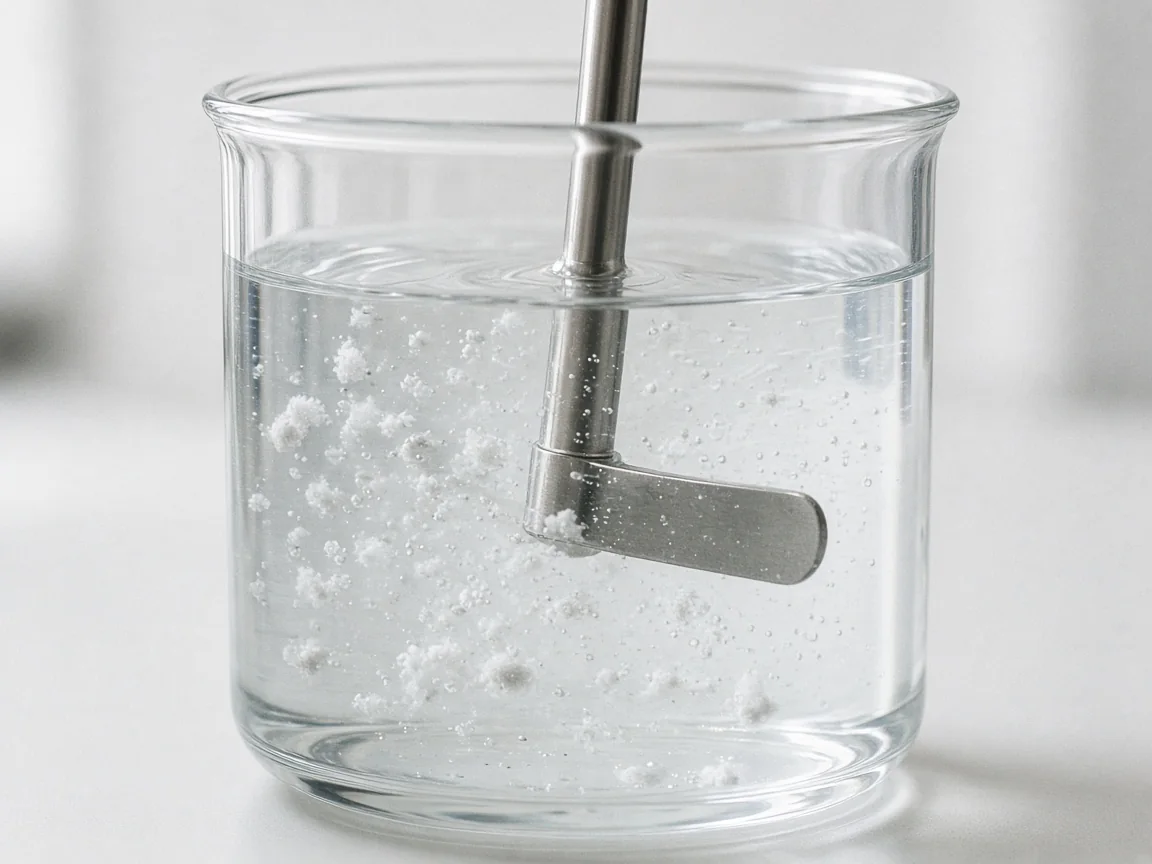
A jar test is a small-scale copy of the coagulation, flocculation and settling stages in your plant. It is the most reliable way to tell whether a PAC grade suits your water and roughly what dose you will need. The general method below follows the common industry practice described in ASTM D2035; adjust it to your plant's mixing and settling times.
What you need
- A jar tester (gang stirrer) with 4–6 paddles, or several magnetic stirrers
- 4–6 identical beakers, 1 L each
- Fresh, representative raw water (collect it on the day of the test)
- The PAC sample and your current coagulant for comparison
- Pipettes or syringes, a turbidity meter, a pH meter; a colour or UV meter if colour matters
1. Make a stock solution
Dissolve PAC in clean water to make a 1% solution (10 g PAC made up to 1 L). With this solution, 1 mL added to a 1 L jar equals 10 mg/L of product. Prepare it on the day of the test; dilute PAC solutions are less stable over time.
2. Choose a dose range
Pick 4–6 doses that bracket your expected dose, for example 10, 20, 30, 40 and 60 mg/L of product. If you already use a coagulant, include your current dose of that product as a reference jar. Very turbid or coloured water may need a higher range.
3. Rapid mix
Fill each beaker with 1 L of raw water. Start the stirrer at high speed (typically 100–300 rpm), add the doses to all jars at the same time, and mix for about 30–60 seconds.
4. Slow mix (flocculation)
Reduce the speed to about 20–40 rpm for 10–20 minutes. Watch how fast floc appears and how large it grows. If you use a polymer flocculant in the plant, add it at the start of this stage.
5. Settle
Stop the paddles and let the jars settle for 15–30 minutes, or for a time that reflects your clarifier.
6. Measure and compare
Draw supernatant from just below the surface without disturbing the sludge. Record for each jar:
- Turbidity (NTU) of the settled water
- pH after dosing
- Colour or UV254, if relevant
- Floc size, settling speed and sludge volume (your notes)
The best dose is usually the lowest dose that reaches your target turbidity with good, fast-settling floc. Doses beyond that point often add little and can even make results worse.
Tips for reliable results
- Use the same water, temperature and timing for every jar.
- Test again when your raw water changes, for example in the rainy season.
- Compare grades at equal Al2O3 dose as well as equal product dose, since PAC strength varies between grades.
- Confirm jar test results with a short plant trial before switching completely.
Results depend on your water. A jar test shows the trend; your plant trial confirms it.
Want to try this with our PAC? Request a free 1 kg sample with COA. The sample is free; you cover the courier.